Share of planned cleaning zones completed inside the target window during a monitored trial.

Comac evaluates productivity, operator behavior, route repeatability, service readiness, and demo feedback to guide machine choices for modern commercial floor care programs.
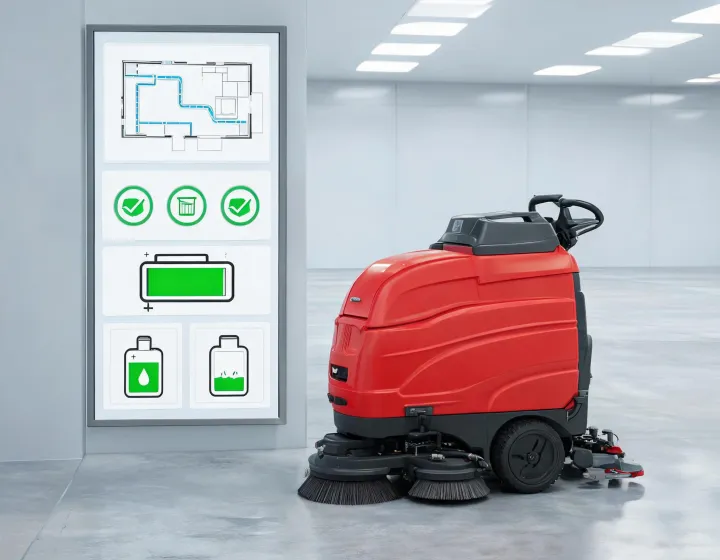
Comac innovation is focused on signals that help people act: where the route slows down, when recovery performance changes, how operators respond to controls, and which wear items need attention before downtime appears. The dashboard below translates those signals into practical decision areas for distributors and facilities.
Share of planned cleaning zones completed inside the target window during a monitored trial.
Supervisor rating for floor dryness, corner recovery, and safe reopening after wet cleaning.
Typical time needed for a trained crew to complete checklist actions without supervisor prompting.
Inspection points covering brush deck, squeegee, tanks, charger, hoses, filters, and control alerts.
Innovation is easier to adopt when the team has clear documents. Comac resources are written for people who compare machines, run demos, train operators, and maintain equipment after the purchase.
Capture floor type, lane width, tank stops, traffic windows, and dry-time expectations before a trial.
Daily actions for filling, brush inspection, recovery tank care, charging, and handover comments.
A structured template for comparing compact scrubbers, ride-on machines, sweepers, and vacuums by site.
The innovation path is not a one-time feature launch. It is a disciplined sequence that turns field use into better specifications, better handover, and better service planning.
Document soil load, turns, refill stops, storage, charging, and the expected time for public access after cleaning.
Use operator feedback, recovery quality, and route timing to confirm whether the chosen machine fits the site.
Convert findings into training notes, inspection points, and distributor support actions that can be repeated.
Compare route changes, wear patterns, and operator feedback before adding capacity or replacing a model.
There is no single correct scrubber. Every gain on one variable usually costs something on another, so Comac frames the decision as honest trade-offs rather than a feature race. The points below show both sides Comac weighs for each cleaning route.
For battery: a ride-on or walk-behind battery scrubber moves freely across open warehouse lanes without trailing a cord through forklift traffic.
Against: batteries add weight and recharge time, the route has to respect run-time per charge, and pack replacement is a recurring cost. For a small, near-outlet retail back room a cabled machine can be lighter and never needs charging space.
For ride-on: on long, open distribution floors a ride-on scrubber covers far more area per hour and reduces operator fatigue across a full shift.
Against: ride-on units need turning room and storage space, and they are oversized for narrow aisles, elevators, and checkout lanes. In mixed buildings Comac often pairs a ride-on for the open floor with a compact walk-behind for edges rather than forcing one machine to do both.
For cylindrical: a cylindrical deck sweeps light debris while it scrubs, which suits warehouse and loading zones where loose grit would otherwise foul a wet pass.
Against: disc-pad decks apply higher point pressure for ground-in marks and polished finishes, but they do not lift debris, so a food plant or retail floor with loose soil may still need a sweeper pass first. The "right" deck depends on what the soil actually is, not on the catalog default.
Practical limits Comac states up front: every machine cleans only as well as the daily blade, brush, and tank checks behind it; battery run-time caps the area a single charge can finish; and a scrubber will not replace a sweeper when loose debris is heavy. Naming these limits early avoids oversizing or undersizing the equipment for the building.
Share a machine list, route notes, and operating targets. Comac can help turn those inputs into a smarter demo, training, or fleet refresh discussion.
Request Review